Beautiful Strategy, No Momentum? Start Here.
The deck was compelling. Your roadshow landed well. Leadership was aligned, the vision was clear, and for a moment it felt like something was going to change.
Then everyone went back to work.
This is the strategy execution gap. The disconnect between what your organization aspires to change and what actually gets done. You've probably lived it.
What was missing was the bridge. A transformation portfolio as an organized body of work built to move your strategy from deck to done.
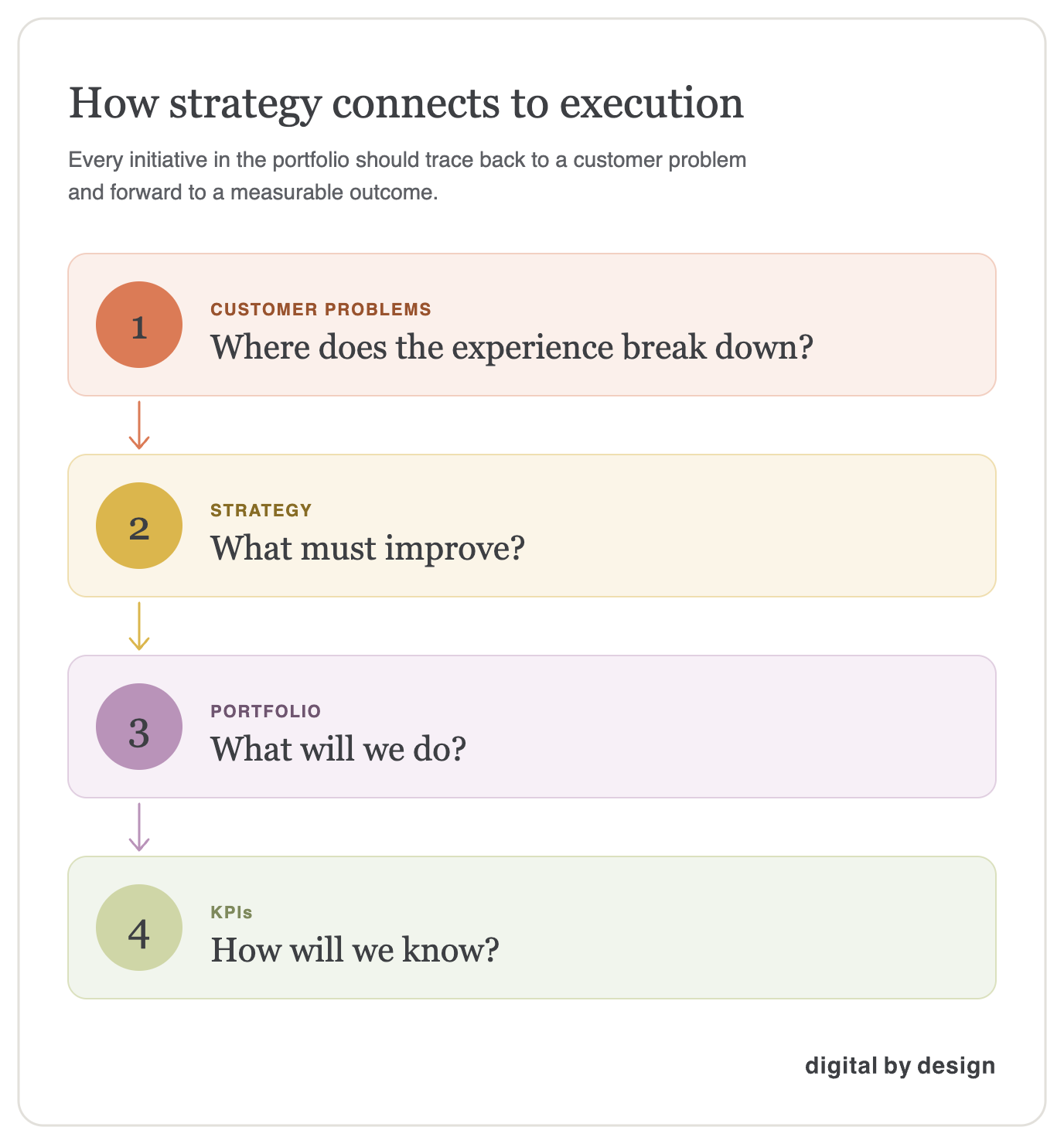
Start with your customer
Before your team builds anything, the first question is simple: what problems are you actually solving for your customer?
Ask your team to walk the customer journey. Where does the experience break down? Where do customers fall off, get frustrated, or give up?
Those friction points are your problems. Have your team flip each one into an improvement area your organization can rally around. Write them in customer terms if your strategy doesn't already. A loyalty program client did this and landed on one problem that touched every stage of their customer lifecycle: Simplify Participation. Clear enough to align a team. Specific enough to own.
Your version might sound like: "Make online and in-store feel like one experience."
Aim for three, no more than five. These become the organizing logic for everything that follows.
Your portfolio may already partly exist
Once your problems are named, resist the urge to commission work from scratch.
Ask your team to look across the organization. Someone is already working on something that belongs here. A pilot no one outside that team knows about. An enrollment form improvement sitting on a product manager's list for two years, underfunded and invisible.
That work belongs in your portfolio. Bringing it in isn't a disruption. It's giving work people already believe in a path to executive visibility, resources, and impact.
Some projects need elevation. Some need funding. Some are obvious now-moves. A few will be net new. Your job is to map them to the problems. Make sure nothing that matters stays invisible.
Check the portfolio against your strategy's KPIs
Your strategy already defined the metrics that matter. Customer growth, retention, enrollment, throughput. Those KPIs came from the strategy your leadership team already agreed to.
Now pressure-test the portfolio against them. Each problem area should connect clearly to at least one of those metrics. If a project can't trace a line back to a KPI in the strategy, it's a candidate to cut or defer.
This is the test you apply. Not whether a project is good. Whether it moves the needle on something your organization already committed to measuring.
If the work is moving those numbers, the strategy is working. If it isn't, that's the signal to revisit.
What's standing between your strategy and the work that would move it forward?