The Five Transformation Resources I Keep Coming Back To
There is no shortage of opinions about transformation. Good resources are harder to find.
I built this list in the field. Standing up ecommerce platforms, launching martech solutions, re-envisioning an omni-channel patient journey with AI. Across all of it, these resources kept proving their worth. The technology evolved. The foundational beliefs did not.
Start here. What technology makes possible.
Watch · MIT Sloan
Why Technology Is Changing Business: Three Digital Capabilities
Jeanne Ross, MIT Sloan
This talk is a few years old. It still stops rooms.
Ross identifies three digital capabilities reshaping every industry, then lands the challenge that reframes everything: "There's so much more you could be doing for your customers." Skip to 2:20. That's where the aspiration lives.
The technology she references has changed. The human problem she describes has not.
Then. How to think about solving the right problem.
Watch · IDEO
IDEO Design Thinking Methodology
Makes the case for empathy as a professional practice, not a soft skill.
Read · HBR, June 2008
Design Thinking
Tim Brown
Before you build anything, understand the actual human problem you are solving. Both are short. Both get ignored in transformation programs every single day.
Then. How to organize your thinking.
Reference Framework
Digital Transformation Framework
Jeffrey Winter
A clean visual model organizing transformation across four domains: People, Process, Technology, and Data.
It does something rare. It puts technology in its rightful place: one part of a larger system, not the center of it. Worth printing. Worth keeping visible.
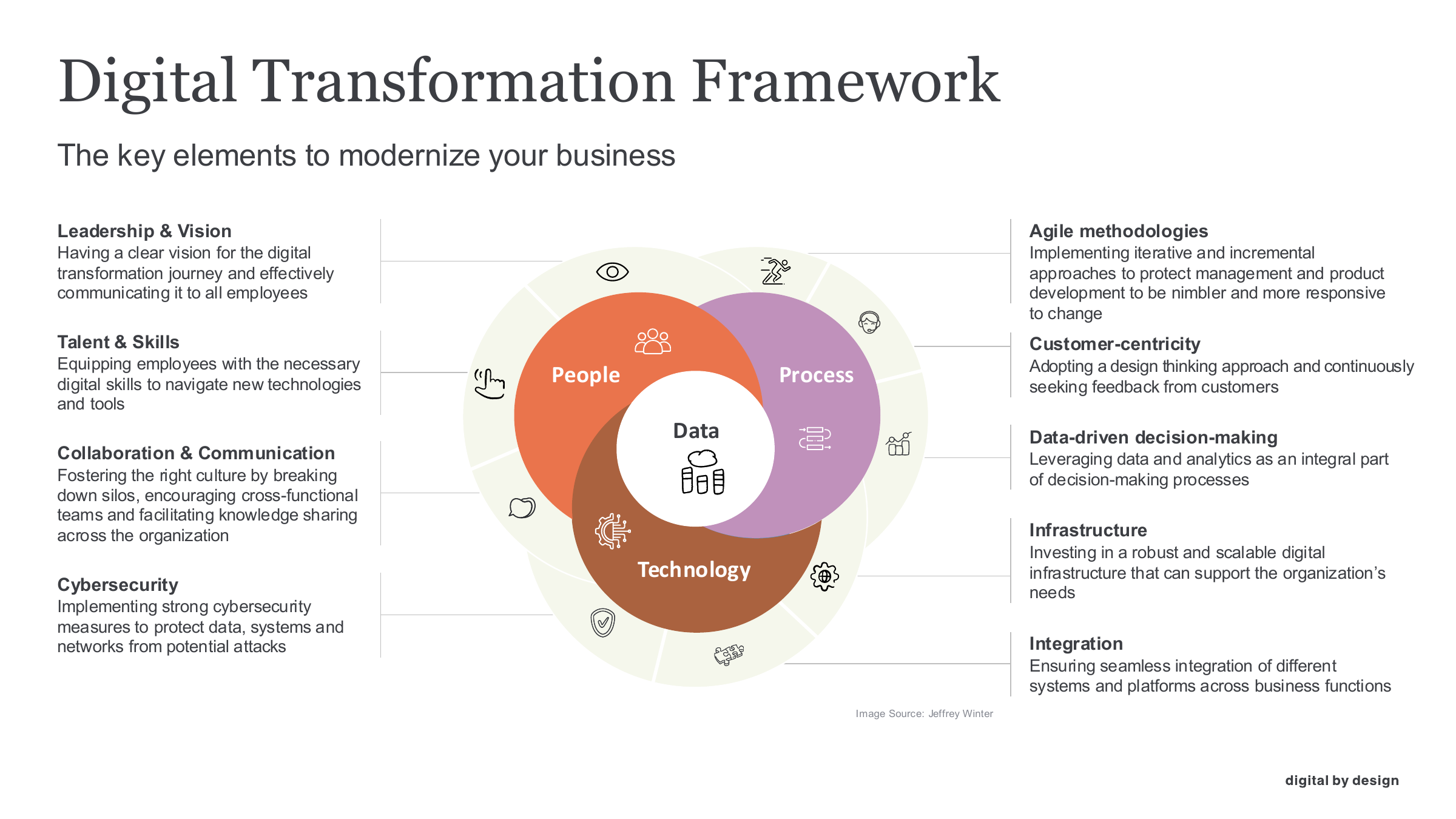
Image credit: Jeffrey Winter
Finally. Why most transformations still fail.
Read · HBR, March 2019
Digital Transformation Is Not About Technology
Behnam Tabrizi
The title says it plainly. The data says it louder.
70% of digital transformation initiatives fail to reach their goals. Of the $1.3 trillion spent on transformation that year, an estimated $900 billion went to waste. Companies focus on specific technologies before doing the harder work of fitting change into overall business strategy.
Nothing in the years since has made this finding less relevant.
Every resource on this list, regardless of format or decade, makes the same argument in a different voice.
Transformation is not primarily a technology problem. It is a people problem, a process problem, an empathy problem. Technology is what makes the solution possible. It is rarely what makes the solution work.
What would you add to this list?